Reasons why The Use of Bite Mark Evidence should not be Admissible in Court.

Bite mark evidence has a high margin of error.

Bite mark evidence is very flawed and should only be used “in combination” with solid evidence when used in trial.

In otherwords, its not an exact science. A bite mark matching advocacy group just conducted a study that discredits bite mark evidence
Share on Facebook Share on Twitter Share on Google Plus Share via Email More Options

Resize Text Print Article Comments
By Radley Balko April 8
In February, I posted a four-part series on the forensic speciality of bite mark analysis. The series looked at the history of the field, how it came to be accepted by the courts as scientific evidence despite the lack of any real scientific research to support its basic assumptions, the innocent people who have been convicted based on bite mark analysis and how the bite mark matchers, advocacy groups like the American Board of Forensic Odontology and their supporters have waged aggressive, sometimes highly personal campaigns to undermine the credibility of people who have raised concerns about all of this.

The series ran during the annual American Academy of Forensic Sciences convention in Orlando, Florida. That conference included a presentation by Adam Freeman, who sits on the executive board of the ABFO, and Iain Pretty, who is not a member of the ABFO, has been critical of bite mark analysis and chairs the AAFS committee on forensic odontology.* Freeman and Pretty were to present the results of a study they had designed with David Senn, another ABFO member and a proponent of bite mark analysis.**

Senn in fact was the main witness for New York County Assistant District Attorney Melissa Mourges during a 2013 evidentiary hearing on the scientific validity of bite mark analysis in State v. Dean. That hearing was the first to assess the science behind bite mark matching since the field came under fire in a landmark 2009 report by the National Academy of Sciences. Ultimately, Senn and Mourges prevailed. Judge Maxwell Wiley ruled that the evidence could be admitted at Clarence Dean’s trial. In fact, to date, every court to rule on the admissibility of bite mark analysis has allowed it to be used as evidence. This, despite an ever increasing number of wrongful convictions, wrongful arrests, and lack of scientific research to support the field, and a new body of research suggesting that its core assumptions are false.

The study:

All of this makes the presentation by Pretty and Freeman particularly interesting. In response to mounting criticism, last year the ABFO released a “decision tree” for bite mark specialists to follow when performing their analysis. The “tree” is basically a flow chart. It begins by asking if there is sufficient evidence to know whether or not a suspicious mark is a human bite. It then asks whether it is in fact a bite, then what distinguish characteristics are noticeable in the bite, and so on.
But the problem with bite mark analysis was never the lack of a flow chart. The problem is that there has never been any real scientific research to support its two main underlying premises — that human dentition is unique, and that human skin is capable of registering and recording that uniqueness in a useful way. And the research that has been done strongly suggests those two premises are not true. The flow chart was just adding a series of procedures to a method of analysis that is entirely subjective, and that lacks basic scientific quantifiers like probability and margin for error.

Yet the ABFO wanted to show that its flow chart worked. So last year, the organization put together an exam to prove its effectiveness. Pretty and Freeman, with consultation from Senn and others within the organization, gave 39 ABFO-certified bite mark analysts photos of 100 bite marks, then asked them to answer three preliminary questions, all based on the decision tree chart. The average analyst who participated in the study had 20 years experience as a forensic odontologist. Here are the three questions they were asked:

Is there sufficient evidence in the presented materials to render an opinion on whether the patterned injury is a human bite mark?
Is it a human bite mark, not a human bite mark, or suggestive of a human bite mark?
Does the bite mark have distinct, identifiable arches and individual tooth marks?
That last question is asking if, once the analyst has determine that the mark is a human bite, the mark contains enough distinguishing features to be of value as evidence.

Interestingly, the intent of this study was to measure consensus, not whether the analysts were actually correct in their conclusions. Consensus is important, particularly in a field that relies so much on pattern matching and subjective analysis instead of quantifiable data. Consensus also shows predictability, which is also an important characteristic when assessing whether a field is legitimately based in science. There will of course occasionally be cases in which the evidence is ambiguous, but if a cross section of experts from a particular field consistently fail to reach consensus conclusions after looking at the same pieces of evidence, you have to start asking if the field is much more than guesswork.

But it’s also notable that there was no effort here to determine the rightness or wrongness of the answers. For example, if 10 out of 10 analysts agree that a mark on human skin is a human bite, that would suggest that the decision tree succeeded at fostering consensus. If only 7 out of 10 agree, that’s more troubling. But it would be even more troubling if the seven in the majority were also wrong.

The study didn’t measure for accuracy in part because the photos were taken from actual cases, so for many of them, whether or not the bite is actually human has never been definitively determined. But as I pointed out in my original series, it’s also keeping the field’s tendency to be more concerned about methodology than veracity. ABFO conducts its certification exams in a similar manner. The candidates are evaluated only on their method of analysis, not on on whether or not they’re actually correct in matching a bite mark to the correct dental mold.
This reflects an ugly reality about the pattern-matching fields of forensics: Because they’re so subjective, it isn’t difficult for attorneys on either side of a case to find an expert who will testify to the conclusion they’re looking for. In these fields then, the most important attribute in a witness is not that they be accurate, but that they sound accurate — that they be more convincing to a jury than the expert on the other side. Juries don’t like wishy-washy witnesses. They like witnesses who seem sure of themselves, who speak with authority. But in forensic specialties as subjective as pattern matching, certainty is a red flag. Most of the time, an honest witness should hedge, speak in probabilities, and avoid definitive conclusions. But this means that the least honest experts can often be the most persuasive, and there’s a clear incentive for prosecutors and defense attorneys to seek them out.

Finally, note that this study also did not ask the examinees to actually match a mark to the teeth of an individual human being the way this sort of evidence would be presented in court. (A previous competency test administered by bite mark critic Michael Bowers in 1999 found a 60 percent error rate among the analyst test takers.) It only asked the three preliminary questions above.

So in sum, this study only measured the ability of ABFO-certified experts to come to a consensus, and only on the most basic, preliminary questions about a piece of evidence.

The results

Even within these limited parameters, and even when designed and administered by the field’s biggest advocates, this study shows that bite mark analysis fails.

The first question — again, whether the test provided sufficient evidence to determine whether or not the photographed mark was a human bite — isthe most basic question a bite mark specialist should answer before performing an analysis. Yet the 39 analysts came to unanimous agreement on just 4 of the 100 case studies. In only 20 of the 100 was there agreement of 90 percent or more on this question. By the time the analysts finished question two — whether the photographed mark is indeed a human bite — there remained only 16 of 100 cases in which 90 percent or more of the analysts were still in agreement. And there were only 38 cases in which at least 75 percent were still in agreement. (These figure come from my own examination of the raw data, as well as processing of the data done by the Innocence Project.)

By the time the analysts finished question three, they were significantly fractionalized on nearly all the cases. Of the initial 100, there remained just 8 case studies in which at least 90 percent of the analysts were still in agreement.

“These results are really disturbing,” says Paul Giannelli, a law professor at Cast Western Reserve University who specializes in scientific evidence. Giannelli also serves on the National Commission on Forensic Science, started by President Obama to address and remedy the shortcomings in forensic evidence outlined in that 2009 NAS report. “But they aren’t all that surprising. There have been a number of cases over the years in which one bite mark analyst testified that a mark was a human mark, while another testified it was something entirely different, for example a bug bite, or an indentation from a belt buckle.”

Peter Bush, who with his wife Mary heads up the University of Buffalo research team that has cast doubt on the integrity of bite mark analysis (and who has been attacked by the community of bite mark analysts and their supporters for that research), agrees: “When there have been exonerations of people convicted with bite mark evidence, the forensic odontologists have said that the problem is with the analysts — that they’re rogue or incompetent experts who didn’t do the analysis properly. This is just another piece of evidence that’s it’s both of these things. It’s the improper analysis, but it’s also the very nature of the evidence itself.”

To put these results in perspective, it might help to ask what might have happened if a similar exam had been given to specialists from a more science-based field of forensics, such as DNA analysis.

“It would be difficult to set up a DNA test that was exactly the same, but if you could, you’d see overwhelming agreement,” Giannelli says. “I’d expect it to be unanimous. And on the questions where it wasn’t unanimous, you’d be able to go back and find the source of the problem — whether it was tainted evidence, or some glitch in the exam. With bite mark analysis, you can’t really even go back, because it’s just a subjective disagreement over what the analysts are seeing.”

Chris Fabricant, the director of strategic litigation for the Innocence Project who is challenging bite mark evidence in several cases across the country, points to a similar study of fingerprint analysts published in 2011 that found 99 percent agreement. “Contrast that to some of the questions in this study, in which the level of agreement among the analysts was only slightly better than randomness,” Fabricant says.

The reaction

The bite mark community reacted with shock, disappointment, and ultimately an effort to suppress the results of the study. According to reliable sources within the ABFO, David Senn initially wanted to cancel the panel at the AAFS conference in which Freeman and Pretty were to present the results. These sources say Senn was astonished at the results, and told other members of the ABFO that he was “reeling” from them. He also apologized to the organization for his role in the study.

In the end, the organization did proceed with the presentation of the results, but then played down their significance. Newly-elected ABFO president Gary Berman briefly mentioned the study in his quarterly message to the organization’s members.

In order to improve the study of bitemarks the ABFO developed a decision tree to assist practitioners in the proper selection and pathways of analysis in bitemark analysis. The ABFO has conducted preliminary research, presented in Orlando, designed to evaluate the first step of a revised decision tree; statistical analysis of the study showed inconsistent overall agreement among the individuals who participated in the project. The ABFO in reaffirming its commitment to ensure accuracy in bitemark analysis is revising the decision tree to ensure reliable results by forensic dentists and will be conducting additional studies this year.

While it’s commendable that the ABFO is attempting to create guidelines that will “ensure reliable results,” it’s far more troubling that the current guidelines don’t, that the unreliable results those guidelines produce have for years been used and continue to be used in court, and that rather than running to courtrooms across the country to halt the convictions, imprisonments and pending executions based on the results, the organization continues to fight for its members’ ability to testify using the very analysis it now concedes is flawed.

In an email in response to my query, Berman blamed the poor design of the study for the results. “Post analyses of the results indicate that the design of the survey and the design of Step 1 of the decision tree may be flawed, and that an ABFO guideline term may be the root cause,” Berman wrote. “The troublesome term, ‘suggestive of a human bitemark’, is one of the currently recommended terms for confidence that a pattern is or is not a bitemark.”

Berman writes that some of the test-takers may have answered the first question in the affirmative (that there was sufficient evidence to show that the mark was a human bite), but then changed their mind as they answered the other questions. He writes, “they were loathe to go back and change the answer to the negative . . . Instead they selected the hedged, and available third choice, ‘suggestive of a human bitemark.’”

Berman’s explanation raises another common criticism made by skeptics of bite mark evidence, although perhaps he raised it inadvertently: Because so much of their value as expert witnesses relies on their credibility, there’s a strong disincentive to change their minds about their conclusions once they’ve made them, even when new evidence suggests they should. If an analyst is loathe to admit a mistake in an anonymous proficiency study, it doesn’t bode well for his ability to admit to a mistake after putting his name and reputation behind court testimony, or in an affidavit leading to an arrest.

Indeed, bite mark analysts have concocted some fantastic theories of culpability even after a suspect convicted based on their testimony was found not to be a match to the semen taken from a victim who was raped, or even to the saliva taken from the bite mark itself. On more than one occasion, for example, a bite mark analyst has confronted a DNA mismatch on semen taken from a rape victim by arguing that someone else must have raped the victim while the suspect implicated by their testimony must have held the suspect down and bit her.

But even more concerning than the results of the study itself, the ABFO has since decided to hold off on publishing those results until the organization can tweak the design of the study and conduct it again, a process that’s expected to take at least a year.

“If this were truly a science-based organization, I would not only expect them to be extremely troubled by the results of this study, I would expect them to want to publish the results,” says Paul Giannelli. “And sooner rather than later, so that they could be considered in any pending criminal cases in which bite mark evidence is a factor.”

The ABFO did release the raw data from the study in spreadsheet form to a few people, but won’t release the presentation given at the AAFS meeting, nor will they publish the data in a journal or another publicly assessable format, at least until the completion of the second study. “We are in the process of modifying the decision tree, the language, and then we will be running the study again,” Adam Freeman wrote in response to an email query. “The results of both studies will then be sent to the [Journal of Forensic Sciences] for publication.The release of the presentation at this point would be premature. ”

Critics like Fabricant are skeptical. “If the results had been more to their liking, I can’t imagine that they’d be objecting over the language in their own study, then taking another year or so to rerun the study to get more favorable results before releasing the data. In the meantime, people are suffering in prison. Some are fighting a death sentence.”

One of the pending criminal cases is the one mentioned at the start of this post: that of Clarence Dean, which is expected to go to trial sometime this year. As noted above, that case included an important evidentiary hearing in which a New York judge ruled that bite mark evidence is admissible and scientifically valid. Many other judges have made that ruling in the past, but this was the first such ruling since the publication of the NAS report in 2009. The prosecutor in Dean’s case is Melissa Mourges, a fierce advocate for bite mark matching who, as I explained in the series in February, has not only advocated for bite mark analysis as a field, but has waged nasty, often highly personal attacks on those who have raised concerns about its legitimacy.

Mourges included a reproduction of the ABFO’s “decision tree” in her brief for the bite mark hearing in the Dean case. She cited the tree as another example of the bite mark community’s dedication to accuracy:

An important Guideline revision was added in February 2013 when the ABFO voted to include a bitemark flow chart or decision tree, included below. Properly used, the decision tree will guide forensic odontologists’ investigatory paths leading to proper conclusions based on the quality of the bitemark and the teeth of the suspected biters. This new guideline offers specific recommendations for forming degrees of linkage conclusions based on the quality of both injury features and suspected biter dentitions.

Mourges attended the presentation by Pretty and Freeman at the AAFS conference in February. I reached out to the Manhattan DA’s office where Mourges works to ask for her official reaction to the study. She didn’t respond, but the office did issue a statement from Chief Assistant District Attorney Karen Friedman Agnifilo:

This study reinforces the importance of basing decisions on the best possible evidence available. The use of forensic odontology, properly performed, has been and continues to be a valuable tool to aid in the identification of assailants and can also be used to help place victims, many of whom are children, out of harm’s way. Equally important, forensic odontology is used to exclude and exonerate suspects.‎ Each time an injury is recognized as a bitemark and swabbed, investigators gain both DNA evidence and potential bitemark identification. Forensic odontology differs from DNA evidence in that it may not be dispositive, but it is probative. Undeniably, bitemarks have significant evidentiary value, which is why this type of evidence is admissible in all 50 states.

Agnifilo’s statement conflates a lot of issues, and I examined several of the points she makes in the February series. But briefly, few would object to swabbing potential bite marks for DNA. Rather, critics of bite mark evidence fault the attempt to match marks on human skin to human teeth. The fact that bite mark evidence is admissible in all 50 states is convincing only if you believe the courts have done an adequate job of keep bad science out of criminal cases. Part two of the February series argues that they haven’t. Agnifilo’s point about the quality of the evidence is a good one. But it remains true that even with the most pristine bite mark evidence, there’s no scientific research to support the contention that the marks we make with our teeth are individually, or to what extent they’re unique, or that, even if they were unique, that human skin is capable of preserving that uniqueness in a way that allows it to be analyzed.

The Manhattan DA’s office insistence on standing behind bite mark evidence is interesting in and of itself. Current Manhattan DA Cyrus Vance, Jr., was elected in 2009 on a platform of “community justice,” and won endorsements from criminal justice reform advocates — including, interestingly, Peter Neufeld and Barry Scheck, co-founders of the same Innocence Project that is now feuding with Mourges in court. On its website, Vance’s office stresses the importance of fairness and sound evidence in preventing wrongful convictions:

The Manhattan District Attorney’s Office spares no effort in seeking justice in every case that comes before it. Through the years and around the country, innocent men and women have been convicted of crimes they did not commit. This not only robs an innocent person of his or her freedom, it leaves a criminal on the street, free to commit more crimes.

To protect New Yorkers and ensure justice, District Attorney Vance created the Conviction Integrity Program in March 2010. The Program is comprehensive in scope, and is unique in purpose: not only does it address claims of actual innocence, it also seeks to prevent wrongful convictions from occurring . . .

The Conviction Integrity Policy Advisory Panel is comprised of leading criminal justice experts, including legal scholars and former prosecutors, who advise the Office on national best practices and evolving issues in the area of wrongful convictions.

The work of the Conviction Integrity Program, combined with the Office’s commitment to using the most advanced scientific and investigative tools available, has made the cases brought by the Office stronger for victims and more fair for defendants.

But meanwhile, at least two of Vance’s top lieutenants continue to defend a field of forensics that has contributed to at least 24 wrongful convictions and arrests around the country, despite numerous studies showing it lacks any basis in science, including one organized by the field’s leading advocacy organization.

Finally, I noted in my original series that last fall, the National Institute for Science and Technology announced the members of the forensic odontology subcommittee that will study the scientific validity of bite mark matching. The committee is one of several that will study various fields of forensics as part of the federal government’s push toward reform in light of the 2009 NAS report. Incredibly, 10 of the 16 members are either practicing bite mark analysts, or are open advocates of the practice, including the chairman, Robert Barsley. It’s a development one critic of bite mark matching likened to starting a committee to investigate the scientific validity of astrology, then stacking it with astrologists.

Pretty and Freeman’s study is a major development in the field of bite mark analysis. It’s one you’d think would attract the attention of the committee charged with investigating whether bite mark analysis is suitable for court. The committee held its first meeting on February 16. The results of the ABFO study were by then well known to the members affiliated with ABFO. According to the webcast and public notes from the meeting, chairman Barsley did include the ABFO “decision tree” in his presentation. He also incorrectly compared the uniqueness of bite marks to fingerprints, and noted that while he couldn’t point to a citation of a study showing that human dentition is unique, “there are studies that lead us to believe this is true.” (In fact, the only peer-reviewed, scientifically rigorous study of the uniqueness of human dentition has been conducted by Peter and Mary Bush’s team, and they’ve found no basis for that assertion.) Curiously missing from Barsley’s presentation was any discussion of the ABFO study showing that the decision tree failed to produce a consensus among even the ABFO’s most experienced analysts.

As the ABFO hems and haws on this study and takes another year to redesign it, ostensibly to achieve more favorable results, bite mark evidence continues to be used in criminal cases, and existing bite mark cases continue to move forward. Over the last several months there have been new filings in the death penalty cases of Eddie Lee Howard in Mississippi, and Jimmie Duncan in Louisiana. At least 15 people convicted with bite mark evidence are currently awaiting execution.

Meanwhile, just last week a sheriff in northern Indiana announced that he’ll be assembling a “forensic dentistry team” within his department. From the Chicago Tribune:

Sheriff David Reynolds recently swore in three local dentists as part of the department’s forensic dentistry team . . .

The dentists will do everything from matching bite marks with suspects or victims, to using dental records to identify victim’s remains, Reynolds said . . .

Over the years, Reynolds has used forensic dentists a number of ways.

“We used them for rape cases, investigating bite marks,” he said, as well as for remains . . .

“There were other cases where people were bitten and we were able to take (dental) models and pictures and match them up to bite marks on the victims.”

So even as we await the results of the ABFO’s do-over on its own study to assess the validity of this field, not only do those convicted due to bite mark analysis remain in prison, law enforcement groups are still using it to win convictions. It’s almost as if those 24 exonerations never happened.

(*Forensic odontology or forensic dentistry, includes the controversial field of bite mark matching, but also the more accepted practice of using dental records to identify human remains.)

(**Senn did not respond to my request for comment. In an email, Pretty acknowledged the study, the results, and that the ABFO will be conducting another study to be published next year. But because the study was administered by the ABFO, using ABFO case studies, he wrote that “it would be wrong of me to make any comments on the work beyond those that were made at the AAFS.”)
Radley Balko blogs about criminal justice, the drug war and civil liberties for The Washington Post. He is the author of the book “Rise of the Warrior Cop: The Militarization of America’s Police Forces.”
Share on Facebook
Share on Twitter
Comments
Most Read
1
Think Walter Scott’s death is ‘another Ferguson’? Cops don’t.
2
Apple’s new diverse emoji are even more problematic than before
3
Enough with the Scandinavians already
4
The Insiders: The Democratic Whackjob Survey
5
The sugar lobby’s sour tactics
The Most Popular All Over

Salon
Rand Paul just walked out of an interview after being pressed on a question

The Baltimore Sun
Commercial real estate boom reaches Baltimore

The Atlantic
The Abuse of Satire
The Most Popular stories around the web
Get the Opinions Newsletter
Free daily updates delivered just for you.
Our Online Games

Play right from this page

mahjongg-dimensions
Mahjongg Dimensions
Genre(s): Strategy
It’s 3D Mahjongg- you don’t even need to wear 3D glasses!

sudoku
Sudoku
Genre(s): Strategy
Put on your Sudoku hat and get ready for a challenging Sudoku puzzle!

daily-crossword
Daily Crossword
Genre(s): Word
Same fun of crosswords but online!

vegas-world
Vegas World
Genre(s): Card
Vegas World brings synchronous multiplayer gameplay to all of its casino-based classics.

washingtonpost.com
© 1996-2015 The Washington Post

Help and Contact Us
Terms of Service
Privacy Policy
Submissions and Discussion Policy
RSS Terms of Service
Ad Choices

FBI To Formally Open New South Florida HQ

Follow CBSMIAMI.COM: Facebook | Twitter

The FBI’s new South Florida field office in Miramar. (Source: CBS4)

MIAMI (CBSMiami) – There will be a ribbon cutting and dedication ceremony Friday for the FBI’s new South Florida field office in Miramar.

FBI Director James Comey and U.S. Rep. Frederica Wilson are scheduled to officially open the building which is named for agents Benjamin P. Grogan and Jerry L. Dove, who were killed in a gun battle with bank robbers in South Miami-Dade on Friday, April 11, 1986. The firefight is still considered the bloodiest in the history of the FBI. Agent Grogan was a 25 year veteran of the Bureau. Agent Dove had been with the FBI for four years.

“The naming ceremony and dedication is a fitting tribute to Special Agents Benjamin P. Grogan and Jerry L. Dove. These brave men answered the call of duty and gave their lives to keep our streets, communities and country safe. We owe them and their families a debt of gratitude that can never be repaid,” said Wilson in a statement.

The new $194 million office building contains 330,000 square feet and sits on a 20-acre site adjacent to Interstate 75.

For 28 years, the FBI’s South Florida headquarters was located in North Miami Beach. The field office has jurisdiction over federal cases along Florida’s southeast coast from Vero Beach to Key West.

(TM and © Copyright 2015 CBS Radio Inc. and its relevant subsidiaries. CBS RADIO and EYE Logo TM and Copyright 2015 CBS Broadcasting Inc. Used under license. All Rights Reserved. This material may not be published, broadcast, rewritten, or redistributed. The Associated Press contributed to this report.)

 Related Updates:

Atascadero woman finds out she could be exposed to Hepatitis B, C & HIV

It has been several days since hundreds of letters from the Santa Barbara County health Department were mailed to patients of a local clinic.  Those letters warn patients to get tested for Hepatitis B, C, and HIV. 

“It’s the accident that just keeps on giving,” says Teresa Turner, a resident of Atascadero.

In 2011, 55-year old Turner says a drunk driver crashed into her, sending her to Dr. Allen Thomashefsky’s Santa Barbara Medical Clinic.

“Dr. Thomashefsky is a very friendly person, he seems to be a good guy,” says Turner.  “The office was very clean and there was nothing out of the ordinary.”

At his office, Turner says she underwent therapy.

“Neck, back, and abdominal muscle,” says Turner.  “I had several injections.”

When say this week’s news, a familiar face came up.

“It was announcing who the doctor was and it was Dr. Thomashefsky,” says Turner.

A phone call later to the Santa Barbara County Health Department, Turner was told she needs to get tested for possible Hepatitis B, C, and HIV.  An appointment that could not come soon enough.

“Monday although it is only a couple of days away, it seems like it is very far away,” says Turner.  “They are infectious diseases and I am concerned that they could have been shared with someone else.”

Turner says she knows the test results could be life changing.


“If I was to be infected by one of those, you feel like you are kind of labeled with a virus, how are people going to treat you,” says Turner.


She has made an appointment with her doctor in Paso Robles and hopes her story will help others take the necessary steps to move on.


“Because you don’t want to hide from this,” says Turner.  “It is a very important and serious issue and you have to go on that path and deal with it.”


Atascadero woman finds out she could be exposed to HIV, Hepatiti.

The truth about lies and deception…….honest. Can you Spot a Lie?

THE TRUTH ABOUT LIES AND DECEPTION…….HONEST.

I have read the terms and conditions. Surely the single greatest lie ever told, certainly in terms of the volume of us who have ticked that box knowing that really we haven’t.  However, deception breeds deception and with now defunct computer game shopGamestation taking advantage of the aforementioned ‘fib’ by fiendishly incorporating into the smallprint of their online terms and conditions- that they owned the very soul of anyone whom blindly ticked the box -‘the immortal soul clause’ as it was called.  Over 7.500 people were caught out on April 1st 2010- they were refunded their soul in an email.

6a00d8341c00c753ef0133ef9c3556970b

However lying, deception, untruthful, false, dishonest, mendacious, perfidious, duplicitous, dissimulating, dissembling and double Janus-facedness is a normal human behaviour, not just human, animals deceive too. Koko the Gorilla had been taught sign language and ruthlessly blamed the ripping out of a sink from a wall on her pet kitten (Koko signed on the return of her keepers…..”The cat did it!”).  If we are to take an evolutionary view it is asurvival mechanism, a simple smile to someone you despise or you feel threatened by is a useful tactic to hide any weaknesses that may be exploited by them and hide, deceive them of your true feelings. However false smiles can be detected if you know where to look – the muscles that generate a warm and honest smile are different to those that are created  when creating a false smile. It’s all in the eyes…you see.

Those lying eyes

real-eyesThe eyes truly are the window to the soul. However don’t be fooled by so called Neuro Linguistic Programming techniques  (a good example of pseudoscience) that if someone is looking up when telling you something then they are lying there is little evidence to support this but is something that your hear still being pedled around every now and then.

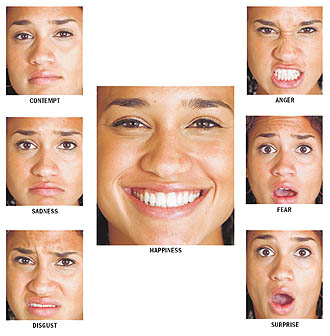
And there lies the crux of the matter…are there any reliable physical cues to deceptiouniversal-facial-expressionsn?  Maybe a more fundamental question is are there any universal responses of facial expression or body language? (The eyebrow flash for recognition of someone  is thought to be pretty universal as an involuntary response.)   Certainly classic research by Ekmaninto facial expression has suggested that there are a handful of truly universal expressions. However deceivingly there is a long tradition ofsupposed cues to deception or ‘tells’ as gamblers would say little unconscious signs of anxiety, uncertainty due to knowingly attempting to convince someone of something you know not to be true. Going red, not being able to look someone in the eye, looking at someone for too long in the eye, rubbing the back of the neck, rubbing the ear lobes, scratching the nose, excessive blinking (note that psychopaths reportedly blink less and maybe that is why they are better at deceiving people) are all ways many think they can spot a liar – but where does the truth lie?

Bad Lie detectors

Many of these are signs of anxiety not necessarily deception, blinkinghowever Polygraphs (aka lie detectors)  have been used for many years in criminal investigations in the United States (and on the Jeremy Kyle show) and provided as evidence, however it measures variations in physiological arousal (not lying) and therefore fundamentally flawed, the American Psychological Association concluded:

The development of currently used “lie detection” technologies has been based on ideas about physiological functioning but has, for the most part, been independent of systematic psychological research. Early theorists believed that deception required effort and, thus, could be assessed by monitoring physiological changes. But such propositions have not been proven and basic research remains limited on the nature of deceptiveness. Efforts to develop actual tests have always outpaced theory-based basic research. Without a better theoretical understanding of the mechanisms by which deception functions, however, development of a lie detection technology seems highly problematic.

For now, although the idea of a lie detector may be comforting, the most practical advice is to remain skeptical about any conclusion wrung from a polygraph.                                          Cited; http://www.apa.org/research/action/polygraph.aspx

truth_9
F.B.I advice for detection

Good lie detectors

Where humans on average can detect lies at marginally above chance level – 54% but surely professionals such as Police officers are better?  When Samantha Mannconducted research into a new area of ‘highstake_liars‘ and found some interesting results, there seemed to be a greater emphasis on story cuesrather than the historic notion  body language cues of the more experienced and stronger lie detectors used in the research.

Watch the slide show giving an overview of the study below…or read the full highstake_liars article.

The fun of deception

However the detection of lies can be fun……………..in a light entertainment kind of way.  The story cues on the clip below may seem so far fetched that it must be a lie…it must be………..mustn’t it?

Captain Psychlite's avatarPsychlite

I have read the terms and conditions. Surely the single greatest lie ever told, certainly in terms of the volume of us who have ticked that box knowing that really we haven’t.  However, deception breeds deception and with now defunct computer game shop Gamestation taking advantage of the aforementioned ‘fib’ by fiendishly incorporating into the smallprint of their online terms and conditions- that they owned the very soul of anyone whom blindly ticked the box -‘the immortal soul clause’ as it was called.  Over 7.500 people were caught out on April 1st 2010- they were refunded their soul in an email.

6a00d8341c00c753ef0133ef9c3556970b

However lying, deception, untruthful, false, dishonest, mendacious, perfidious, duplicitous, dissimulating, dissembling and double Janus-facedness is a normal human behaviour, not just human, animals deceive too. Koko the Gorilla had been taught sign language and ruthlessly blamed the ripping out of a sink from a wall on her pet kitten (Koko signed…

View original post 675 more words

Psychologists in focus; Kevin Dutton: Psychopath Studies

2db9de04c787b5b82a78a8787ea03557_400x400

Video: PSYCHOLOGISTS IN FOCUS; KEVIN DUTTON

FullSizeRender
Dutton takes the view that we often miss what should be the obvious anomaly sidelined by the charm – But is it all smoke and fingers?

Kevin Dutton is a postdoctoral researcher at the University of Oxford.  He is specialises in the study of Psychopaths, but rather than the traditional forensic route Dutton takes interest how the ‘symptoms’ of psychopathy can have an advantage in a modern world that is fraught with stressors.  The psychopath often described as  having a selection of specific traits such as cunning and manipulativeness, lack of remorse or guilt, callousness and lack of empathy, charm, grandiose estimation of self, need for stimulation and pathological lying.  Not the best characteristics to put on a C.V.  It is included in the DSM under the classification of Antisocial Personality Disorder.   However in his book The Wisdom of Psychopaths Dutton discusses how these traits are rewarded in society particularly as resistance to stress where others feel the pressure, psychopaths are able to thrive. Self doubt and fear can impair decision making, the psychopath is arguably resistant to this –but would you want one as your boss?  Dutton is clear that this is far from the glorification of violent psychopaths (stating only a small minority of psychopaths are violent) rather acknowledging that the ‘spectrum of psychopathy‘ which all people can be measured and the right characteristics in the right circumstances can be a force for good – hence his term ‘the good psychopath‘.

Here is a quote from Dutton’s book the Wisdom of  Psychopaths, from James Geraghty cited as one of the UK’s leading neurosurgeons.

I have no compassion for those whom I operate on. That is a luxury I simply cannot afford. In the theatre I am reborn: as a cold, heartless machine, totally at one with scalpel, drill and saw. When you’re cutting loose and cheating death high above the snowline of the brain, feelings aren’t fit for purpose. Emotion is entropy, and seriously bad for business. I’ve hunted it down to extinction over the years.”

Do we need people like this in such high stakes roles where emotion maybe a hindrance rather than a help?  Or is compassion an essential characteristic that allows a surgeon to consider the long term impact of their work?

In fact jobs that Psychopaths are believed to flourish in are;

Kevin Dutton

1. CEO
2. Lawyer
3. Media (Television/Radio)
4. Salesperson
5. Surgeon
6. Journalist
7. Police officer
8. Clergy person
9. Chef
10. Civil servant

here’s the list of occupations with the lowest rates of psychopathy:

1. Carer
2. Nurse
3. Therapist
4. Craftsperson
5. Beautician/Stylist
6. Charity worker
7. Teacher
8. Creative artist
9. Doctor
10. Accountant

Could you spot a Psychopath?  Take the test here.

An online study with over 2 1/2 million British participants found the following results relating to psychopathic tendencies.

Capture

Dutton discusses how Psychopaths process ethical dilemmas differently.

Follow Kevin Dutton on twitter

Captain Psychlite's avatarPsychlite

FullSizeRender Dutton takes the view that we often miss what should be the obvious anomaly sidelined by the charm – But is it all smoke and fingers?

Kevin Dutton is a postdoctoral researcher at the University of Oxford.  He is specialises in the study of Psychopaths, but rather than the traditional forensic route Dutton takes interest how the ‘symptoms’ of psychopathy can have an advantage in a modern world that is fraught with stressors.  The psychopath often described as  having a selection of specific traits such as cunning and manipulativeness, lack of remorse or guilt, callousness and lack of empathy, charm, grandiose estimation of self, need for stimulation and pathological lying.  Not the best characteristics to put on a C.V.  It is included in the DSM under the classification of Antisocial Personality Disorder.   However in his book The Wisdom of Psychopaths Dutton discusses how these traits are rewarded in society…

View original post 341 more words

Decades After Selena’s Death, Case Continues to Make News

10613bf4-a526-4826-9f82-d814e18ec836-medium Death of a Rising Star: March 31, 1995: Selena is shot to death by the President of her Fan Club.

Her death, 20 years ago today, on March 31, 1995, rocked the Latin music community and devastated millions of fans. The Grammy-winning performer was a fashion icon and a role model for many young women. As TIME described her shortly after her death, “[s]he was the embodiment of young, smart, hip, Mexican-American youth, wearing midriff-baring bustiers and boasting of a tight-knit family and a down-to-earth personality — a Madonna without the controversy.”

When she died, she had just recorded her first album in English and, per CBS News, “was poised to become a crossover success when her death turned her into a legend.”

Her death was even more shocking because it came at the hands of a woman once considered one of Selena’s biggest fans: Yolanda Saldivar, who had founded Selena’s fan club in San Antonio.

Saldivar had also been hired to manage Selena’s clothing boutique, Selena Etc., but was fired a few weeks before the shooting when Selena’s family discovered that she had been embezzling money, Selena’s father told the New York Times in 1995. Selena demanded that Saldivar return some of the boutique’s financial documents, and they agreed to meet at a Days Inn motel in Selena’s hometown of Corpus Christi. But Saldivar refused to turn over the documents, shot the singer and then fended off police during a nine-hour standoff while she sat in a pickup truck in the motel parking lot, holding a gun to her own head.

While Selena has retained her fan base and even attracted a new generation of fans following her death, Saldivar remains in prison, where she is serving a life sentence for the murder. (She will be eligible for parole in 2025.) She has filed a string of unsuccessful appeals, arguing, among other things, that prosecutors coerced her confession and that she received ineffective legal counsel.

She may be better off in prison, however, given the fury of Selena devotees. In 2012, Saldivar’s brother told TMZ that she was still being held in solitary confinement for her own safety. Selena’s father recently told a Corpus Christi TV news reporter that he thought an early release would be a harsher punishment than life in prison.

“Not very many people like her,” he said.

Read TIME’s original coverage of Selena’s death, here in the TIME Vault: Death of a Rising Star

Press Release | Forensic Science Misconduct: A Dark and Cautionary Tale | @csidds

Integrity and Accountability—The Declining State of Physician Health and the Urgent Need for Ethical and Evidence-Based Leadership

IMG_9516“A body of men holding themselves accountable to nobody ought not to be trusted by anybody.”
― Thomas Paine 

USDTL drug testing laboratory claims to advance the”Gold Standard in Forensic Toxicology.”  “Integrity: Results that you can trust, based on solid science” is listed as a corporate value. “Unlike other laboratories, our drug and alcohol testing begins and ends with strict chain of custody.” “When people’s lives are on the line, we don’t skip steps.”  Joseph Jones, Vice President of Laboratory Operations explains the importance of chain-of-custody in this USDLT videopresentation.

Dr. Luis Sanchez, M.D. recently published an article entitled Disruptive Behaviors Among Physicians in the Journal of the American Medical Association discussing the importance of  of a “medical culture of safety” with “clear expectations and standards.”  Stressing the importance of values and codes-of-conduct in the practice of medicine, he calls on physician leaders  “commit to professional behavior.”

Sanchez is Past President of the Federation of State Physician Health Programs (FSPHP).  According to their website the FSPHP “serves as an educational resource about physician impairment, provides advocacy for physicians and their health issues at local, state, and national levels, and assists state programs in their quest to protect the public.”  In addition the FSPHP “helps to establish monitoring standards.”  The FSPHP is the umbrella organization of the individual State PHPs.

Sanchez is also the previous Medical Director of the Massachusetts state PHP, Physician Health Services, Inc. (PHS).  According to their website PHS is a “nonprofit corporation that was founded by the Massachusetts Medical Society to address issues of physician health. PHS is designed to help identify, refer to treatment, guide, and monitor the recovery of physicians and medical students with substance use disorders, behavioral health concerns, or mental or physical illness.

PHPs recommend referral of physicians if there are any concerns such as getting behind on medical records.  As PHS Associate DirectorJudith Eaton explains “when something so necessary is not getting done, it is prudent to explore what else might be going on.”  If the PHP feels that doctor needs an assessment they will send that doctor to a “PHP-approved” facility “experienced in the assessment and treatment of health care professionals.” The physician must comply with any and all recommendations of the assessment center.  To assure this the physician must sign a monitoring contract with the PHP (usually five years). USDTL is one of the labs PHPs have contracted with for forensic drug and alcohol testing.


Forensic Drug and Alcohol Tests: The Need For Integrity and Accountability of the Sample
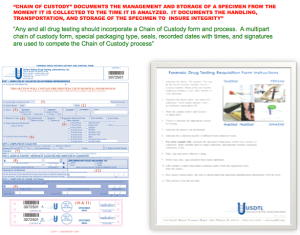
Screen Shot 2013-09-04 at 6.14.30 PM

“Forensic” drug-testing differs from “clinical” drug-testing in how the results are used. “Clinical” tests are used for medical purposes in diagnosing and treating a patient.

A “forensic” test is used for  non-medical purposes.  It is not used for patient care, but for detecting licit and illicit substances in those who should not be using them. Pre-employment and employee assistance and professional monitoring programs are examples.Screen Shot 2014-05-08 at 2.17.18 AM
Forensic testing is held to a higher standards because the consequences of a positive result can be grave and far reaching. A positive forensic test can result in loss of rights of the individual being tested and his or her loved ones. Mistakes are unacceptable.

The Federation of State Medical Boards Policy on Physician Impairment supports this position stating “chain-of-custody forensic testing is critical” (page 14) and the “use of a Medical Review Officer (MRO) for screening samples and confirming sample results” (page 21).

Any and all drug testing requires chain-of-custody. The custody-and-control form is given the status of a legal document because it has the ability to invalidate a test that lacks complete information.  Chain-of-custody provides assures specimen integrity. It provides accountability. 
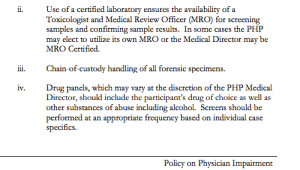
Screen Shot 2014-11-06 at 7.25.46 PM The job of the MRO is to ensure that the drug testing process is followed to the letter and reviews the Custody and Control form for accuracy.  The MRO also rules out any other possible explanations for a positive test (such as legitimately prescribed medications).  Only then is the test reported as positive.

The legal issues involved in forensic testing mandate MRO review. According to The Medical Review Officer Manual for Federal Workplace Drug Testing ProgramsScreen Shot 2013-12-19 at 12.20.46 PM
the sole responsibility of the MRO is to”ensure that his or her involvement in the review and interpretation of results is consistent with the regulations and will be forensically and scientifically supportable.”

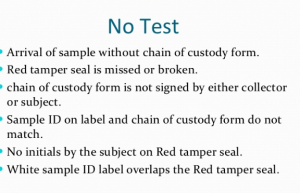
“Fatal flaws” such as lack of chain-of-custody form, missing tamper proof seal, missing signatures, or a mismatch of the sample ID and chain of custody ID invalidate the test.   It is not reported.  Tight chain-of-custody and MRO review is critical for the accountability and integrity of the sample.

The Medical Review Officer Certification Council  provides a certification process for MROs. They Screen Shot 2014-04-30 at 12.47.25 PMalso  follow their own Code of Ethics.   In accordance with these standards PHS has an MRO to review all positive tests.  As added assurance the FSPHP guidelines state that all positive tests must be approved by the Medical Director.

Regulation and the Medical Profession–The need for Integrity and Accountability in Physician Leadership and Health Care Policy.

Screen Shot 2014-11-09 at 12.26.14 PM

Good leadership requires correct moral and ethical behavior of both the individual and the organization. .  Integrity is necessary for establishing relationships of trust.  It requires a true heart and an honest soul.  People of integrity instinctively do the “right thing” in any and all circumstances.  The majority of doctors belong to this group.

Adherence to ethical codes of the profession is a universal obligation.  It excludes all exceptions.  Without ethical integrity, falsity will flourish.

The documents below show fraud. It is intentional.  All parties involved knew what they were doing, knew it was wrong but did it anyway.  The schism between pious rhetoric and reality is wide.

Screen Shot 2014-08-20 at 12.01.33 PM

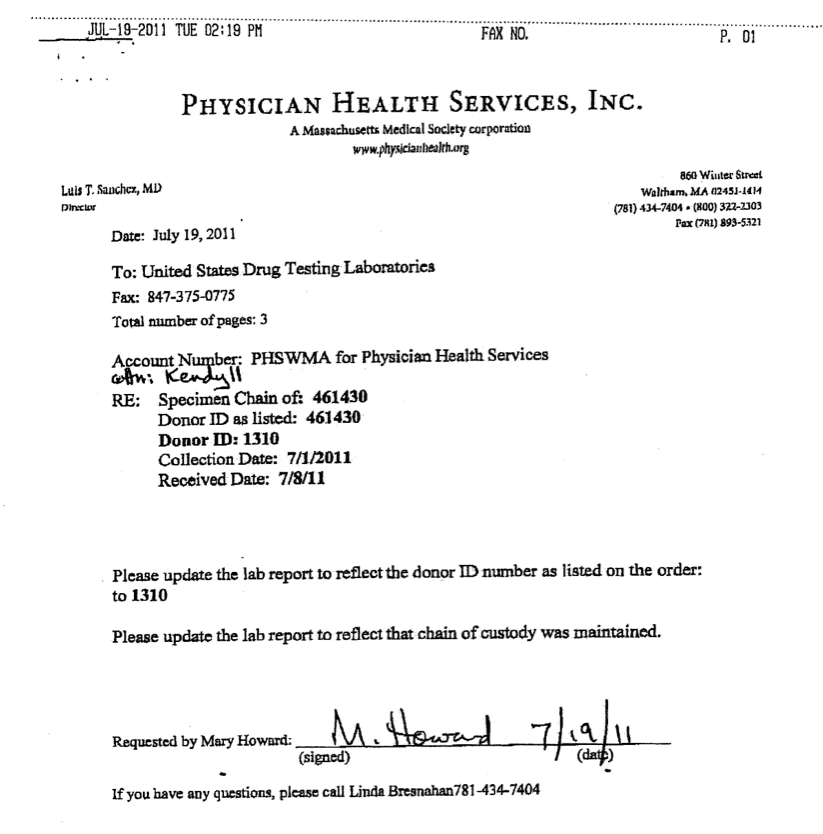
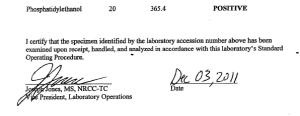
The  July 19th, 2011 fax from PHS seen below is in reference to the lab report from USDTL seen above.  In it PHS requests the report be “updated”to donor ID number “1310” and  to “reflect that the chain of custody was maintained.”

The lab report is a positive test for the alcohol biomarker (Phosphatidyl Ethanol) or PEth, an alcohol biomarker introduced by the Federation of State Physician Health programs and marketed by USDTL and other labs to detect  covert alcohol use..

There is no record of where, when or by whom it was collected.

Screen Shot 2014-11-06 at 11.17.32 PMBoth the donor ID # and chain of custody are listed as 461430.

The purpose of chain-of-custody is to document the location of  a specimen in real time.  “Updating” it is not an option.  It is prohibited.  Updating the “chain of custody to reflect that chain of custody was maintained”  is a clear indicator that it was not maintained.

ID #1310 is the unique identifier I was issued by PHS.  It is used as a unique identifier, just like a name or social security number, to link me to any sample collected for random drug and alcohol screening. #1310 identifies me as me in the chain-of-custody.    On July 1st, 2011 I had a blood test collected at Quest Diagnostics.

IMG_8756 2

The sample was collected at Quest Diagnostics on July 1, 2011 but these documents were not obtained until December 3, 2011 and were included in the “litigation packet” which documents chain-of-custody and is generated on any and all forensic drug testing.   It provides proof that the test was done on who it was supposed to have been done and that all required procedure and protocol was followed. It protects the donor form being falsely accused of illicit substance use.  In most employee drug-testing programs the litigation-packet is provided on request immediately.  It is a transparent process.  This is not the case, however, at PHS.

I requested the litigation packet immediately after the positive test was reported on July 19, 2011.  PHS first refused, then tried to dissuade me.  They finally agreed but warned there would be “unintended consequences.    The entire litigation packet can be seen here:   Litigation Packet 12:3:2011

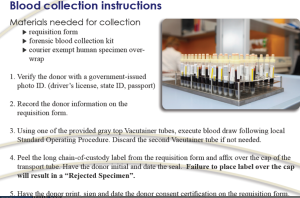
The positive sample has no chain-of-custody linked to me, no date, and no indication where it was collected or who collected it.   In addition there was no “external” chain of custody for the sample. The custody-and-control form was missing.

With multiple fatal flaws (6/6)  rendering it invalid, USDTL should have rejected it by their own written protocol.

Screen Shot 2013-12-19 at 12.20.46 PM

USDTL did not reject it. The document below shows that USDTL added my ID # 1310 and added a collection date of July 1, 2011–the day I submitted the sample.
Screen Shot 2014-09-15 at 5.27.21 AM

“REVISED REPORT PER CLIENTS REQUEST”  

And in doing so the lab that claims “integrity” and “strict chain of custody” readily, and with no apparent compunction” manufactured a chain-of-custody and added a unique identifier by faxed request.

The litigation packet was signed by Joseph Jones on December 3, 2011.   There was no record of where the sample was from July 1st to July 8, 2011. No external chain-of-custody or custody-and-control form was evident in the litigation packet.
Screen Shot 2014-07-28 at 6.50.01 PM

The V.P. for Laboratory operations for the lab that claims “strict chain of custody” and that “doesn’t skip steps” “when “peoples lives are on the line” verified a positive test as positive with no custody and control form, no external chain of custody and 6/6 fatal flaws.  What is so shocking is that  this was done without compunction or pause.  As a forensic test ordered by a monitoring program Jones knew full well it would result in significant consequences for someone.  He knew that someones “life was on the line,” knew it was wrong, and did it anyway.

A person of conscience would never do this.  It is unethical decision making  that goes agains professional and societal norms.  A “moral disengagement” that represents a lack of empathy and a callous disregard for others.  I would not consider doing something like this for any price and here it appears to be standard operating procedure.

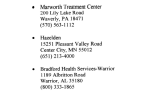
PHS reported the positive test to the Medical Board on July 19, 2011 Positive PEth July 19, 2011-1.  It was used as a stepping-stone to request an evaluation at one of three  “PHP-approved” facilities (Marworth, Hazelden and Bradford). The Medical Directors of all three facilities can be seen on this list list called “Like-Minded Docs.”  The MRO for PHS, Dr.Wayne Gavryck,  whose job was to review the chain-of-custody and validate its integrity before reporting it as positive is also on the list.  See this simplified schematic of how it works in Massachusetts.  It shows how this is a rigged game.

Expecting to be diagnosed with a non-existent problem and admitted for non-needed treatment I requested an evaluation at a non-12 step facility with no conflicts-of-interest.  Both PHS and the Medical Board refused this request in one of four violations of the Establishment Clause of the 1st amendment.
Screen Shot 2014-07-27 at 7.55.16 PM copy

I chose Hazelden.  The Medical Director was aware that I had just signed  a patent license agreement for an epinephrine auto-injector and he had a child with a peanut allergy.  We talked about the device and discussed the problems with current management.  I think it was because of this added personal interaction that he did not “tailor my diagnosis” as PHS most certainly requested.  Seeing me as a person rather than an object, I believe,  enabled his conscience to reject it. My discharge diagnosis found no history of alcohol issues but they could not explain the positive test. Unable to rule out that I drank in violation of my PHS contract they recommended I attend AA.

PHS mandated that I attend 3 12-step meetings per week and requested that I obtain names and phone numbers of fellow attendees so they could contact them to verify my attendance.  They also mandated that I discontinue my asthma inhalers (as the propellant contains small amounts of ethanol) that had been controlling my asthma and preventing serious attacks for the previous ten years.  I was threatened that if I had to use the inhalers or one day late on the increased payments I would be reported to the Board and lose my license.

Screen Shot 2014-11-09 at 10.03.16 PM

Screen Shot 2014-11-08 at 11.57.25 PM

Sanchez states that my request for the “litigation packet” was processed on December 5, 2011 (two days after Jones signed off on it) and adds the “testing laboratory is willing to support the test results.”

In the interim I filed a complaint with the College of American Pathologists.  I also requested the missing external chain of custody documents from Quest.

Screen Shot 2014-08-20 at 12.15.52 PM

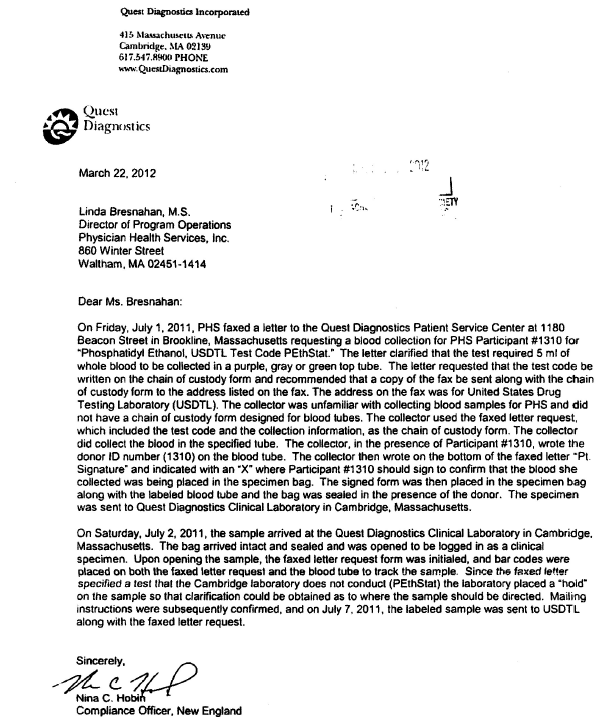
I never received the chain of custody from Quest.  Instead I received a letter from Nina Tobin, Compliance Manager for Quest documenting all the errors but written to sound as if some sort of protocol was maintained.  Tobin claimed the specimen was inadvertently logged as a clinical specimen but sent on to USDTL a week later.  (See Quest Letter )

Screen Shot 2014-11-09 at 10.06.46 PM

The Chief of Toxicology at MGH wrote a letter to the Board documenting all of the misconduct and irregularities stating that it was an “intentional act” perpetrated by PHS.  MLLv3finalJacob_Hafter_Esq_copy.

This letter, as well as the opinions of everyone outside of PHS was ignored. So too were any opinions of my two former Associate Directors at PHS.   The e-mail below dated October 10th, 2011 is to to Drs. John Knight and J. Wesley Boyd and I am referring to their article Ethical and Managerial Considerations Regarding State Physician Health Programs  that was about to be published. We had hoped that it would draw more attention to the problems with PHPs.

Screen Shot 2014-11-10 at 10.36.13 AM

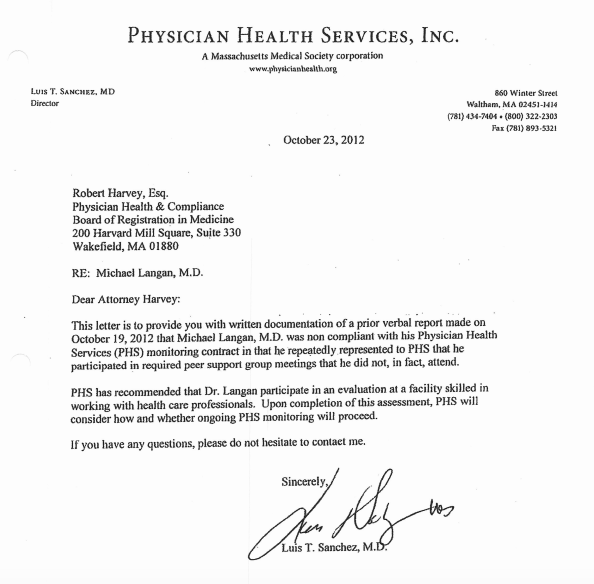
I was subsequently reported as “non-compliant” with AA meetings.    They could not give any details of where or when.  They then misrepresented a declaration of fact (I stated that I had started going to a specific meeting on a specific date) as an admission of guilt by saying I was referring to a different meeting.     10:23:12 PHS Letter to BORM-noncompliance.

My Chief at MGH, his Chief and others held a  conference with PHS and attempted to remove me from PHS and replace the monitoring contract with one of their own.  They refused.   When confronted with the fabricated test they dismissed it and focused on sending me to Kansas to one of the “disruptive physician” Psikhuskas where they are using polygraphs (despite the AMAs stance that it is junk science) and non-validated neuropsychological instruments that detect “character defects” to pathologize the normal.

I refused. Had I gone to Kansas I would have been given a false diagnosis and my career would be over. This is what they do.
Screen Shot 2014-11-08 at 12.05.52 AM

Screen Shot 2014-09-05 at 7.28.02 PM

Amy Daniels, the investigator for the College of American Pathologists contacted me in December of 2012 to see how things were going since USDTL “amended” the test.  Daniels told me that the College of American Pathologists confirmed my allegations and, as an Accrediting Agency for Forensic Toxicology mandated that USDTL correct it.  (Labs can lose accreditation if they do not comply with CAP  Standards for Forensic Drug Testing). This was done on October 4, 2012.

PHS denied any knowledge of an amended test.  I also wrote an e-mail to Joseph Jones requesting the document but he did not reply.

I contacted CAP.   On December 11, 2012 Dr. Luis Sanchez wrote a letter stating  “Yesterday, December 10 2012, Physician Health Services (PHS) received a revision to a laboratory test result”

 “The amended report indicates that the external chain of custody protocol [for that sample] was not followed per standard protocol]” 

Sanchez dismisses this test as irrelevant, rationalizing neither PHS nor the Board based any actions on the test and they would “continue to disregard” it.

Screen Shot 2014-11-08 at 1.19.44 AM

The  logic is that it was my behavior that resulted in any consequences.  My “non-compliance” in October led to my suspension and the test had nothing to do with it.   The sole reason for reporting me to the Board in 2011 was the positive test.  There is no other pretext to use.  It is misattribution of blame as without the test, now invalidated, there would have been no AA meetings to say I was non-compliant with.

In response to a civil complaint PHS, Quest and USDTL all took the position that the results of the fraudulent testing had absolutely nothing to do with anything.

And in response to the allegations of forensic fraud the labs claimed there was no forensic fraud because this was not a “Forensic” test but a “clinical” test.     The argument was that “clinical” tests do not require chain-of-custody and it was his behavior not these tests that resulted in consequences.   

As a “clinical” test I knew it was considered Protected Health Information (PHI)  under theHIPAA-Privacy Rule.  A patient must give written consent for any outside entities to see it.  Obtaining lab tests previously required the consent of both the patient and the ordering provider.  What PHS and the labs were apparently unaware of was the changes to the HIPAA-Privacy rule giving patients increased rights to access their PHI.   The changes removed the ordering provider requirements.  A patient has a right to obtain lab test results directly from the labs and has 30 days to do it.  CAP agreed.   USDTL sent me all of the documents.  They can be seen below:

August 6, 2014 to Langan with health materials.

The documents sent by USDTL are notable for two things:

1.  The e-mail from me to Joseph Jones dated December 10, 2012.  It can be seen on page 22 of the USDTL documents.  Screen Shot 2014-11-10 at 11.21.18 AM

Screen Shot 2014-11-10 at 11.22.00 AM

2. USDTL document confirming PHS knew the test was amended 67-days before they said they did.Screen Shot 2014-08-06 at 4.50.02 PM

The document shows PHS and Sanchez were aware of the invalidity of the test on October 4, 2012.   Instead of correcting things they initiated machinations to throw me under the bus.  They officially reported me to the Board for non-compliance on October 19, 2012.

The December 11, 2012 letter signed by Sanchez states “Yesterday, December 10, 2012, PHS received a “revised report” regarding the test.  The documents show he knew about it 67-days prior.

Screen Shot 2014-11-04 at 10.51.24 PM

Although USDTL complied with the HIPAA-Privacy Rule and CAP, Quest did not.   Quest Diagnostics refused to send me copies of their lab reports claiming it was confidential and protected information that required PHS consent.  Quest required I sign a consent form with multiple stipulations regarding PHS.  I refused and contacted the Department of Justice -Office of Civil Rights.  The DOJ-OCR agreed with me and I received the Quest documents

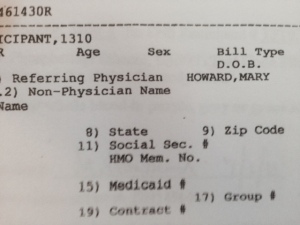
Remember a “clinical” test can only be ordered by a physician in the course of medical treatment.  It requires authorization from the patient to obtain a “clinical” specimen and it requires written authorization as to who sees it.  Referring physician was Mary Howard.
image

And below is the fax from PHS to Quest from July 1, 2011 also requested by Mary Howard.  The signature on the front is not mine.  In addition I gave the blood at 9:30 and was in my clinic at MGH at 12:23 so it couldn’t be. The WC 461430 R are dated July 2, 2011.  This is a “clinical” not “forensic” sticker.  The “R” indicates a red top tube.  The other sticker is USDTL and indicates it was logged in on July 8, 2011.

Screen Shot 2014-09-15 at 7.18.25 PM

What does it all mean?    Blood left in a red top tube ferments. This is basic chemistry.  The PEth test needs to be refrigerated and shipped overnight to prevent this.  In addition it needs to be collected with a non-alcohol wipe in a tube that has an anti-coagulant or preservative so that it does not ferment.    It requires strict procedure and protocol.

When I gave my blood on July 1st, 2011 it was as a “forensic” test per my contractual agreement with PHS.

On July 2, 2011 it was changed to “clinical.”   Why?  because “forensic” protocol would have invalidated it.

The only conceivable reason for doing this was to bypass chain-of-custody procedures.  My unique identifier #1310 was removed and the clinical specimen number was used for chain-of-custody.    The R in 461430R indicates a red top tube.

By holding on to it for one week the blood fermented.    As it was July with an average temperature close to 90 they overshot their mark a bit.   My level of 365 is consistent with heavy alcohol use–end stage half-gallon a day type drinking.

Quest then forwarded it to USDTL with specific instructions to process it as a “clinical” sample.  USDTL complied and  processed it as a clinical specimen which was reported it to PHS on July 14, 2011.

Screen Shot 2014-07-28 at 12.41.01 PM

PHS then asked USDTL to add my forensic  ID # 1310 and add a collection date of July 1, 2011 so it would appear “forensic” protocol was followed.    The reason Jones signed the “litigation packet” on December 3, 2011 was because that was when the “litigation packet” was manufactured.  A “clinical” sample does not produce one.

Screen Shot 2014-07-28 at 12.40.13 PM

USDTL willingly complied with this request.

Screen Shot 2014-08-20 at 11.59.24 AM

PHS then reported this as a “forensic” test to the Medical Board on July 19, 2011 and requested a reevaluation.

Screen Shot 2014-11-09 at 1.17.24 PM

The distinction between “forensic” and “clinical” drug and alcohol testing is black and white. PHS is a monitoring program not a treatment provider. The fact that a monitoring agency with an MRO asked the lab to process and report it as a clinical sample and then used it forensically is an extreme outlier in terms of forensic fraud. The fact that they collected it forensically, removed the forensic components and let it sit in a warehouse for a week is  abhorrent.  The fact they then specifically requested it be processed as a clinical sample deepens the malice. The fact that they then reported it to the Board as a forensic sample and maintained it was forensic up until just recently makes it egregious. But the fact that the test was changed from “positive” to “invalid” on October 4th, 2012 and they then reported me to the Board on October 8th,  2012 for “noncompliance,” suppressed it and tried to send me to Kansas where I would be given a non-existent diagnosis to delegitimize me for damage control makes it wantonly egregious.  This is political abuse of psychiatry.

Accountability requires both the provision of information and justification of what was done.

For doctors it is very difficult to obtain the information. As seen here, they put up a gauntlet to prevent the provision of what is immediate in all other drug testing programs.  I now have all of the information. What it shows is clear. This was intentional.  It was no accident.  They knew what they were doing, knew it was wrong but did it anyway.

Accountability also requires that those who commit misconduct suffer consequences. The PHPs have also put up barriers to this.    With no regulation or oversight they have no apparent accountability.

My understanding is that it works this way.   The Medical Board, Medical Society and Departments of Public Health have no oversight.   The MMS has an ethics committee but all they can do is “educate” the person if they feel there was a violation.  The DPH won’t even look at it and the Board is complicit.

My understanding is that they have convinced law enforcement that this is a “parochial” issue that is best kept within the medical community.  They have also created the impression that they are “friends” of law enforcement.  I have heard from many doctors that they have tried to report misconduct, civil rights violations and crimes to the police, AGO, and other law enforcement agencies only to be turned back over to the PHP.     By saying the physician is “impaired” it delegitimizes and invalidates the truth.  “He’s just a sick doctor,  we’ll take care of him.”  That physician then suffers consequences effectively silencing the rest.

PHS uses the Board to enforce punitive measures and temporize.   The Board puts blind faith in PHS.  Blind faith that defies common sense ( mandating phone numbers at anonymous meetings)  and disregards the law (Establishment Clause violations that are clear and well established).    The Board also temporizes to cause damage.

In my case they required a psychiatric behavioral evaluation.  I was given the choice of Kansas and a few other Like-minded assessment centers.

After petitioning for  multiple qualified psychiatrists that were summarily rejected months later for no reason one of the Board Attorneys suggested  Dr. Patricia Recupero, M.D., J.D. who is Board Certified in Forensic Psychiatry and Addiction Psychiatry.   The Board had used her in the past but not recently.  Seeing that she had been used by the Board for fit-for-duty evaluations in the past the Board accepted my petition.

Dr. Recupero wrote an 87-page report. She concluded I was safe to practice medicine without supervision, that I had never had an alcohol use, abuse or dependence problem, and that PHS request for phone numbers was inappropriate. She also documented PHS misconduct throughout my contract and concluded it was PHS actions, not mine, that led to my suspension.   What she describes is consistent with criminal harassment.  She documents the falsification of neuropsychological tests and confirms the forensic fraud.  What did the Board do?  Ignored their very own recommended and approved evaluator.

One measure of integrity is truthfulness to words and deeds.  These people claim professionalism, ethics and integrity.  The documents show otherwise.  The careers and lives of doctors are in these peoples hands.

Similar fraud is occurring across the country.  This is an example of the institutional injustice that is killing physicians.  Finding themselves entrapped with no way out, helpless and hopeless they are feeling themselves bereft of any shade of  justice and killing themselves.  These are nothing more than bullies and accountability is essential.  The “disruptive physician” moral panic has harmed the Medical Profession.

Dr. Clive Body in his book  Corporate Psychopaths   writes that “Unethical leaders create unethical followers, which in turn create unethical companies and society suffers as a result.”  And according to Dr. Robert Hare in  Without Conscience  “If we can’t spot them, we are doomed to be their victims, both as individuals and as a society. ”

Wes Boyd notes that valid complaints from physicians are often dismissed as “bellyaching” by the PHPs.  Complacent that these are just good guys helping doctors and protecting the public the complaints are dismissed, tabled, deflected or otherwise ignored.  Bellyaching??   Is this bellyaching.

It is my opinion that what you see here is indefensible  Procedurally, Ethically, and Legally.

Procedurally it goes beyond negligence and represents fraud.  It violates every procedural guideline, regulation and standard of care including their very own.

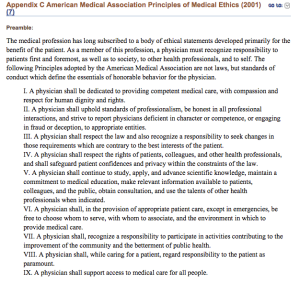
Ethically it violates everything from the Hippocratic Oath to  AMA Medical Ethics to the MRO Code of Conduct.

And where was PHS MRO Wayne Gavryck? By my count he violated at least 4 of the 6 Codes of Ethical Conduct.
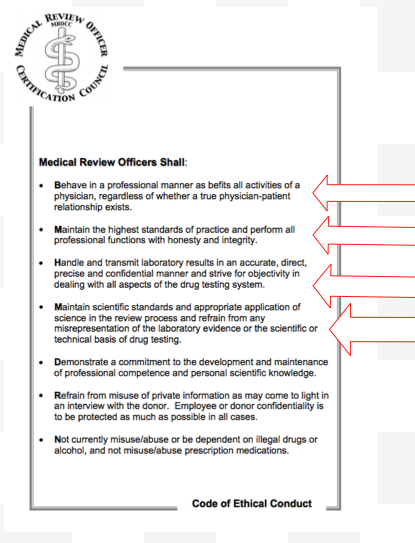
Screen Shot 2014-11-10 at 1.04.20 PM

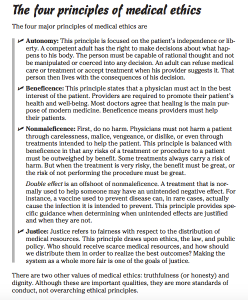
What was done here violates the most fundamental ethical principles of Medicine -Autonomy, Beneficence, Nonmaleficence and justice.

Intentionally falsifying a laboratory or diagnostic test to refer for an evaluation or support a diagnosis or give unwarranted “treatment” is unconscionable.  Abuse under the utility of  medical coloration is especially egregious.

The information provided herein should negate any “peer-review” protection or immunity afforded PHS as it is undeniably and egregiously in “bad faith.” Moreover, the ordering a “clinical” test is outside PHS scope, practice, and function of PHS. According to M.G.L. c. 111, § 203 (c):

An individual or institution, including a licensed or public hospital, physician credentialing verification service operated by a society or organization of medical professionals for the purpose of providing credentialing information to health care entities, or licensed nursing home reporting, providing information, opinion, counsel or services to a medical peer review committee, or participation in the procedures required by this section, shall not be liable in a suit for damages by reason of having furnished such information, opinion, counsel or services or by reason of such participation, provided, that such individual or institution acted in good faith and with a reasonable belief that said actions were warranted in connection with or in furtherance of the function of said committee or the procedures required by this section.

Dr. Luis Sanchez and Dr. Wayne Gavryck need to be held to the same professional standards as the rest of us.

If you can support either of them procedurally, ethically, or legally, any one of them, then I will turn in my medical license with a bow on it.  If they did not commit negligent fraud by standards of care and procedural guidelines, egregious moral disengagement in violation of ALL ethical codes for the medical profession and society and break the law then disprove me.  Just one will do.

But you can’t do this then I ask that you speak up and take a stand. Either defend them or help me hold them accountable.  If a crime is committed it needs to be addressed.  Ignoring encourages more of the same.

And if this cannot be supported procedurally, ethically or legally then I want to know what is going to be done about it?

How low does the moral compass have to go before someone takes action?

Doctors are dying across the country because of people just like this.  They have set up a scaffold that removes the usual checks and balances and removed accountability.   It is this institutional justice that is driving many doctors to suicide.

So the evidence is above.  Either defend them or help me draw unwanted attention to this culture of bullying and abuse. So I am asking you to contemplate if  what you see here is ethically, procedurally or legally sound.   If you can show just one of these then I stand corrected. But if you cannot justify this on any level then I want you to help me expose this criminal enterprise. Either defend it or fight it. Silence and obfuscation are not acceptable.

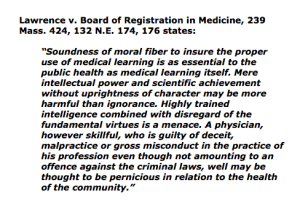
Screen Shot 2014-11-10 at 1.34.48 PM

Screen Shot 2014-11-10 at 1.36.13 PM

Screen Shot 2014-11-10 at 10.24.58 AM

Screen Shot 2013-09-04 at 2.22.36 AM

Screen Shot 2014-11-10 at 9.15.46 PMScreen Shot 2014-11-10 at 9.23.36 PMScreen Shot 2014-11-10 at 9.19.08 PMScreen Shot 2014-11-10 at 8.54.21 PMget-attachment.aspx

Screen Shot 2013-09-04 at 2.21.51 AM

Screen Shot 2014-11-07 at 8.02.36 PM

Screen Shot 2014-11-07 at 7.35.18 PM

mllangan1's avatarDisrupted Physician

Press Release | Forensic Science Misconduct: A Dark and Cautionary Tale | @csidds.

capture11

Originally posted on FORENSICS in FOCUS @ CSIDDS | News and Trends:

mbAPphoto

Don’t expect a “whodunnit” version of CSI victories in this Op-ed blog article about a darker side of the forensic sciences. It is from an author with ample forensic credentials and experience from both within and outside criminal courts of the US. The article has topics ranging from the continued use of outdated or grossly over hyped “CSI” methods, ethical and moral failures in some forensic groups, to the criminal courts inability to understand much of anything about what is “real ” versus self-serving personal opinion called “science.” A measure of proof confirming these systemic problems is the article’s presenting a glimpse into the multi-million dollar costs to taxpayers for damages won by those wrongfully convicted with the help of court-qualified forensic testimony…

View original post 33 more words

The validation of the polygraph examination in forensic psychiatry

An interesting abstract to establish the validity of the use of lie detection techniques when establishing insanity.

Access the full site here.

 INTRODUCTION

There is increasing demand for psychiatric expert testimony in criminal proceedings. A person is responsible for his actions unless he is subject to the penal code, Section 34 h, insanity. Mental illness is not sufficient to determine insanity; it must be proven that the patient did not understand what he had done, did not comprehend the inappropriateness of his actions: or could not have avoided performing the deed. Opponents argue that the expert testimony is not scientific and not professional and alternatively that the mentally ill avoid responsibility even when there is no connection between the illness and the offence.

OBJECTIVES

The polygraph examination is an important instrument for confirming credibility of the testimony but it has not yet been investigated in the field of forensic psychiatry.

AIMS

To examine the validity of a polygraph examination in psychotic patients. To compare polygraph tests with psychiatric examinations.

METHODS

Patients were tested with a polygraph examination on there misjudged psychotic behaviour.

RESULTS

24 patients signed a consent form, but not all eventually participated. All patients received anti-psychotic medications. In general valid polygraph examination can be performed to patients with the psychotic illnesses (i.e. schizophrenia). Agitated or cognitive deprived patients tests were not reliable. The psychiatric examinations or the expert testimonies were in accord with the polygraph examination.

CONCLUSIONS

Preliminary data indicate that polygraph examinations are valid in patients with the psychotic illnesses. But not in agitated or cognitive deprived patients. Expert testimonies were found reliable in determining insanity.

 CAPTAIN PSYCHLITE

Captain Psychlite's avatarPsychlite

An interesting abstract to establish the validity of the use of lie detection techniques when establishing insanity.

Access the full site here.

 Introduction

There is increasing demand for psychiatric expert testimony in criminal proceedings. A person is responsible for his actions unless he is subject to the penal code, Section 34 h, insanity. Mental illness is not sufficient to determine insanity; it must be proven that the patient did not understand what he had done, did not comprehend the inappropriateness of his actions: or could not have avoided performing the deed. Opponents argue that the expert testimony is not scientific and not professional and alternatively that the mentally ill avoid responsibility even when there is no connection between the illness and the offence.

Objectives

The polygraph examination is an important instrument for confirming credibility of the testimony but it has not yet been investigated in the field of forensic psychiatry.

Aims

View original post 118 more words