Visualizing The Odds Of Dying From Various Accidents
Fatal accidents account for a significant number of deaths in the U.S. every year. For example, nearly 43,000 Americans died in traffic accidents in 2021.
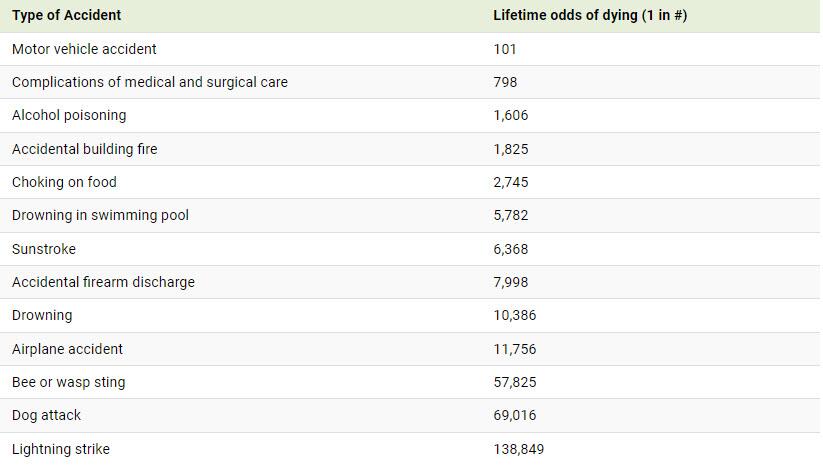
To help you understand your chances, we’ve compiled data from the National Safety Council, and visualized the lifetime odds of dying from various accidents.
Data and Methodology
The lifetime odds presented in this graphic were estimated by dividing the one-year odds of dying by the life expectancy of a person born in 2020 (77 years).
Additionally, these numbers are based on data from the U.S., and likely differ in other countries.
For comparison’s sake, the odds of winning the Powerball jackpot are 1 in 292,000,000. In other words, you are 4000x more likely to die by a lightning strike over your lifetime than to win the Powerball lottery.
Continue reading below for further context on some of these accidents.
Motor Vehicle Accidents
Motor vehicle accidents are a leading cause of accidental deaths in the U.S., with a 1 in 101 chance of dying. This is quite a common way of dying, especially when compared to something like bee stings (1 in 57,825).
Unfortunately, a major cause of vehicle deaths is impaired driving. The CDC reports that 32 Americans are killed every day in crashes involving alcohol, which equates to one death every 45 minutes.
For further context, consider this: 30% of all traffic-related deaths in 2020 involved alcohol-impaired drivers.
Drowning
The odds of drowning in a swimming pool (1 in 5,782) are significantly higher than those of drowning in general (1 in 10,386). According to the CDC, there are 4,000 fatal drownings every year, which works out to 11 deaths per day.
Drowning also happens to be a leading cause of death for children. It is the leading cause for kids aged 1-4, and second highest cause for kids aged 5-14.
A rather surprising fact about drowning is that 80% of fatalities are male. This has been attributed to higher rates of alcohol use and risk-taking behaviors.
Accidental Firearm Discharge
Lastly, let’s look at accidental firearm deaths, which have lifetime odds of 1 in 7,998. That’s higher than the odds of drowning (general), as well as dying in an airplane accident.
This shouldn’t come as a major surprise, since the U.S. has the highest rates of gun ownership in the world. More importantly, these odds highlight the importance of properly securing one’s firearms, as well as learning safe handling practices.
As a percentage of total gun-related deaths (45,222 in 2020), accidental shootings represent a tiny 1%. The two leading causes are suicide (54%) and homicide (43%).
By B.N. Frank People are dying from COVID-19 and people are dying with COVID-19. There is a difference, however, that hasn’t stopped deaths from being… U.S. Deaths Being Attributed to COVID-19… Go to Source Author: Activist PostSeptember 20, 2021
What to expect when you reach the border of life and death. A Medical Study. — JcgregSolutions
“We characterize the testimonies that people had and were able to identify that there is a unique recalled experience of death that is different to other experiences that people may have in the hospital or elsewhere,” Dr. Parnia said, “and that these are not hallucinations, they are not illusions, they are not delusions, they are […]
What is the importance of Microbiology in today’s world?
Microbiology is the study of microorganisms such as bacteria, viruses, fungi, and parasites that have a significant impact on human health and the environment. It plays a vital role in disease diagnosis, prevention, and treatment. Microbiology supports advancements in medicine, vaccine development, food safety, environmental protection, and biotechnology, making it essential for global health and scientific progress.
Why is Forensic Science important in modern society?
Forensic Science is crucial in the investigation and resolution of criminal cases. It uses scientific techniques to analyse physical and biological evidence such as DNA, blood samples, fingerprints, and trace materials. This scientific approach ensures accuracy, fairness, and reliability in the justice system, helping law enforcement agencies uncover the truth and deliver justice.
How are Microbiology and Forensic Science connected?
Microbiology and Forensic Science intersect in areas such as forensic microbiology, where microorganisms are analysed for criminal and legal investigations. Microbial evidence can help determine the cause of death, time of death, or sources of contamination. This interdisciplinary connection enhances both scientific research and forensic investigations.
What skills do students gain from studying Microbiology and Forensic Science?
Students develop strong analytical, laboratory, and research skills through practical training and theoretical knowledge. They learn scientific reasoning, attention to detail, problem-solving, and ethical practices, which are essential for careers in healthcare, research, and forensic investigation.
What career opportunities are available after studying these subjects?
Graduates can pursue careers in hospitals, diagnostic laboratories, pharmaceutical and biotechnology industries, research institutions, forensic laboratories, environmental agencies, and law enforcement departments. The combined knowledge of microbiology and forensic science opens diverse and promising career paths.
Conclusion
Microbiology and Forensic Science together form a powerful scientific foundation for addressing modern challenges in healthcare, research, and justice. The Department of Microbiology & Forensic Science prepares students with essential knowledge, practical skills, and ethical values, enabling them to make meaningful contributions to society and scientific advancement.
What is the importance of Microbiology in today’s world? Microbiology is the study of microorganisms such as bacteria, viruses, fungi, and parasites …
WTTV – A recent warning by the Centers for Disease Control and Prevention is prompting a word of caution from food safety experts about preprepared home delivery meal services that are growing in popularity.
Penn State food safety specialist Martin Bucknavage is among those urging caution when signing up for the growing number of preprepared meal delivery services out there.
“We see an increasing number of companies that are selling these home delivered foods, and we oftentimes don’t necessarily know where they come from,” Bucknavage said. “We don’t necessarily know who’s making them, where they’re being made.”
Bucknavage says it’s important for customers to know about the food preparation and handling process. Is the kitchen clean? Are the foods being kept at the proper temperature during preparation and delivery to your home?
“And so it’s really incumbent upon the consumer of that to make sure the product looks right,” he added. “It’s at the right temperature and that there’s not anything that is apparently wrong with the product.”
Checking your food’s appearance and temperature may not protect you if there’s salmonella contamination, but it could save you from other foodborne illnesses like listeria or botulism.
“At the end of the day, when people do have a risk or they feel there’s a risk or they want to avoid risk as much as possible, preparing foods yourself is is often the best way to go through and do it.”
Bucknavage isn’t saying all meal delivery services are bad. But he says it’s a good idea to investigate the preparation and delivery process before signing up for one of them.
FREELAND, MARYLAND (WBFF) — On a tranquil 40-acre farm in Freeland, Rose Brady enjoys a quiet life, far removed from her groundbreaking career with the Baltimore County Police Force.
Brady, who joined the force at 18, was the first female homicide sergeant in the department and played a pivotal role in solving numerous cold cases.
Brady’s journey took a significant turn in 2004 when a chance conversation introduced her to Dr. Rudiger Breitenecker, an Austrian doctor who had preserved DNA slides from over 2,000 sexual assault cases dating back to 1977.
Brady recognized the potential of these slides, saying to the friend who told her about them, “I said, please hold on to everything you have, every slide you have, I said, because this could be a gold mine.”
Her team began reviewing open rape cases, and the DNA hits started coming. “When we got the hit, it was awesome. I mean, I’m telling you, DNA was the gold mine,” Brady said.
The investigation led to the identification of Alphonso Hill, a serial rapist linked to 24 rapes, who was sentenced to 60 years in prison.
Baltimore County State’s Attorney Scott Shellenberger praised the effort, stating, “Baltimore County with these slides was solving cases that no one else in the country could solve.”
Brady’s work brought closure to many victims, with 84 cold cases solved, most thanks to Dr. Breitenecker’s foresight.
Dr. Breitenecker, who passed away, once said, “Once you throw them out, there’s no way to go back and say ‘well I’ll get another one’ so I just thought maybe we shouldn’t throw them out.” His intuition and Brady’s determination have been hailed as heroic.
Now retired, Brady spends her days on her farm, enjoying time with her 6-year-old grandson and hosting a podcast, “Sgt. Brady’s Crime Podcast,” sharing her remarkable story.
Her former colleagues describe her as “one of a kind,” with Chris Grant noting, “She’s just a bulldog. If she gets it in her mind she’s going to do something she’s going to do it and nothing is going to get in her way.”
READ THE COMMENTS (6)
Brady’s legacy is one of justice and peace, both for herself and the many women whose stories she helped bring to light.
Your voice matters. Discussions are moderated for civility. See our guidelines.
Sort by Best
BasicNeeds3 September, 2025It is good to see recognition of exceptional service in bringing offenders to justice. Too many times the individual victim of a rapist is not able to endure the process of reporting, testifying, and seeing the final accountability of a court case. Sergeant Brady became a bridge that connected cas…See moreReply27Share1 reply
ExpatriateMD4 September, 2025Good job Detective! They could use more officers like you ! Show The city how it’s done!Reply8Share
SheriffWalt4 September, 2025Thank you ma’am for your dedication and expertise in bringing many of these crimes to light while solving most of them. Reply3Share
stuartT6 September, 2025Why did Mr. Hill only get a 60 year sentence ? That’s less than 3 years for every rape !!!ReplyShare
In the pursuit of justice, the crime scene represents both the origin of the mystery and the potential solution to it. It is a silent witness to the crime, holding vital clues that can either exonerate the innocent or incriminate the guilty. The methods used to search and process these crime scenes form the cornerstone of modern criminal investigations. This article provides a detailed exploration of crime scene search methods, their significance, types, procedures, and relevance in Indian criminal jurisprudence.
Whether you are a law student, forensic science enthusiast, criminal lawyer, or an informed citizen, understanding these methods offers a fascinating look into the backbone of investigative work.
What Are Crime Scene Search Methods?
Crime scene search methods refer to systematic procedures followed by investigators to locate, collect, preserve, and document physical evidence from a crime scene. The effectiveness of an investigation hinges greatly on how meticulously the scene is examined. A compromised search may lead to crucial evidence being overlooked or contaminated, potentially affecting the trial’s outcome.
Before diving into search methods, it’s essential to understand the broader phases that encompass the crime scene investigation:
Securing and Isolating the Scene
Preliminary Survey
Documentation (photography, sketching, notes)
Systematic Search for Evidence
Collection and Packaging of Evidence
Final Survey
Release of the Scene
The fourth step—systematic search—is where crime scene search methods play their most critical role.
Types of Crime Scene Search Methods
There is no universal technique applicable to every scene. The method chosen depends on the location, type of crime, available personnel, and complexity of the scene.
1. Grid Method
The grid search method involves the scene being searched twice in perpendicular directions, forming a grid. It is highly effective for large, open areas where evidence like shell casings, fibers, or footprints might be dispersed.
Best used for: Outdoor homicide scenes, post-blast scenes, or large-scale assaults.
Advantages:
Increases the likelihood of locating minute evidence
Offers double coverage
Disadvantages:
Time-consuming
Requires more personnel and coordination
2. Spiral Search Method
The spiral method involves a single officer starting from a central point and moving outward (or vice versa) in a spiral path. This method is less structured but sometimes necessary when only one investigator is present.
Best used for: Limited personnel scenarios, underwater searches, or small indoor scenes.
Advantages:
Simple and can be conducted by one person
Useful in confined spaces
Disadvantages:
Risk of uneven coverage
Challenging in cluttered environments
3. Strip (or Line) Search Method
Investigators walk in parallel lines across the scene, typically used in large open areas such as fields or parking lots.
Best used for: Outdoor crime scenes, search for large objects (like weapons).
Advantages:
Systematic and easily supervised
Suitable for large areas
Disadvantages:
Less effective for small or hidden evidence
Requires more manpower
4. Zone (Quadrant) Search Method
The area is divided into zones or quadrants, each assigned to a team or individual. Each section is searched independently using any of the above methods.
Best used for: Indoor scenes, vehicles, multiple-room houses.
Advantages:
Allows division of labor
Facilitates focused searching in complex areas
Disadvantages:
Requires efficient coordination
May cause overlap or missed areas if not properly managed
5. Wheel (or Radial) Search Method
Searchers start from a central point and move outward in straight lines, like spokes of a wheel.
Best used for: Small circular areas, such as intersections or blast centers.
Advantages:
Central point covered thoroughly
Useful for locating origin points
Disadvantages:
Gaps between the “spokes” can lead to missed evidence
Not ideal for large areas
Modern Tools Enhancing Crime Scene Searches
Technology has revolutionized traditional search methods. While manual techniques remain foundational, modern tools supplement them:
1. Drones
Used for aerial photography of large or inaccessible areas—especially in outdoor crime scenes.
2. 3D Laser Scanning
Helps create a virtual model of the scene, allowing for detailed review later.
3. Alternate Light Sources (ALS)
Used to identify biological fluids, fibers, or residues not visible under normal lighting.
4. Metal Detectors and Ground Penetrating Radar (GPR)
Useful for locating buried weapons, bullets, or human remains.
Key Principles in Crime Scene Search
Regardless of the method used, several guiding principles must be followed:
1. Locard’s Exchange Principle
Every contact leaves a trace. Investigators work on the presumption that the criminal has brought something into the crime scene and taken something from it.
2. Preservation of the Scene
No one enters without authorization. Contamination must be minimized.
3. Systematic Approach
The scene must be approached methodically to prevent overlooked evidence.
Each item of evidence must be documented, labelled, and tracked to ensure its integrity in court.
Application in Indian Legal Framework
In India, the Code of Criminal Procedure (BNSS now), Bharatiya Nyaya Sanhita (BNS), and Indian Evidence Act (renamed as Bharatiya Sakshya Adhiniyam) do not prescribe a specific crime scene search method but emphasize evidence collection, documentation, and admissibility.
Relevant Provisions:
Section 173 BNSS – Police report must include details of the scene and collected evidence.
Section 62 BSA (Bharatiya Sakshya Adhiniyam) – Emphasizes on documentary and electronic evidence.
Section 100 BNSS – Mandates proper procedure during search and seizure.
FSL (Forensic Science Laboratory) Involvement: Crime scenes involving unnatural deaths, rapes, bombings, or poisoning often require FSL experts to participate in the scene search to ensure scientific methods are adopted.
Challenges in Indian Context
Despite the growing awareness and legal reforms, crime scene searches in India face the following challenges:
Delayed arrival at the scene due to traffic or jurisdiction confusion
Scene contamination by media, public, or untrained police officers
Lack of trained crime scene officers, especially in rural areas
Inadequate resources for scientific search tools
Improper documentation and poor chain of custody maintenance
Best Practices for Effective Crime Scene Searches
Immediate Securing of the Scene
Use of PPE to prevent contamination
Photographic and video documentation before moving anything
Labeling and preserving evidence with tamper-proof seals
Cross-functional coordination between police, forensic experts, and legal officers
Detailed scene notes with sketches and measurements
Case Studies Highlighting Crime Scene Search Impact
Timely collection of DNA, blood samples, and CCTV footage formed the backbone of the prosecution’s case. A zone search method was primarily used across the crime vehicle and the road area.
2. Aarushi Talwar Case (Noida, 2008)
The mishandling of the crime scene, loss of evidence, and delayed forensic analysis became a textbook case for what not to do at a crime scene.
International Perspective and Indian Progress
Many developed nations have codified crime scene protocols. For example, the FBI has a Crime Scene Search Study Guide, and the UK has the National Crime Scene Strategy. India is gradually adopting these frameworks, with the Directorate of Forensic Science Services (DFSS) playing a key role in upgrading standards.
Several state police forces now have Mobile Forensic Units, and training modules on crime scene search are becoming mandatory at police academies.
Conclusion
Crime scene search methods are not mere technicalities—they are foundational to justice delivery. An efficient search may uncover the truth; a careless one might bury it forever. As forensic science integrates further into criminal litigation in India, awareness and education about these techniques become critical for all legal stakeholders.
Whether a defense advocate contesting the reliability of recovered evidence, or a prosecutor relying on blood spatter analysis, or a judge weighing the admissibility of a fingerprint report—the method of collection holds significant weight.
As India strides toward a more forensic-driven legal system, refining and standardizing crime scene search methods will be a game-changer for both law enforcement and the judiciary.
FAQs on Crime Scene Search Methods
Q1. Who is responsible for searching a crime scene in India? The Investigating Officer (IO), often accompanied by forensic experts and photographers, is responsible for conducting the crime scene search.
Q2. Can evidence be rejected in court due to improper search methods? Yes. If it is shown that the evidence was tampered with or collected without following proper procedures, it may be declared inadmissible.
Q3. What is the first priority upon reaching a crime scene? Securing the scene to prevent contamination and unauthorized entry is the first and foremost priority.
Q4. Is photography mandatory before evidence collection? Yes. Detailed photography ensures that the position and condition of evidence are recorded before being disturbed.
Q5. How are search methods taught in India? Crime scene search techniques are taught in police training academies, forensic science courses, and during workshops conducted by forensic institutions.
Q6. Are drones legally permitted in crime scene search in India? Yes, but their use must comply with DGCA regulations and privacy laws, and usually under official authorization.
Disclaimer: This content is generated with the assistance of artificial intelligence (AI) tools and may contain errors. The content provided herein is not intended for use in any capacity, including but not limited to legal, informational, advisory, or educational purposes, and must not be relied upon under any circumstances. All information must be verified with the original source. Consult an advocate before taking any step.
Abhishek Gandhi is a practicing Advocate at the Delhi High Court and Saket Courts. The areas of practice includes Criminal Litigation – bail applications, appeals, and quashing of FIRs, NDPS, POSH, POCSO cases, Cheque Bounce (138 NI) cases, Matrimonial & Family Law – Divorce, maintenance, domestic violence cases, cybercrime, IPR- Patent, Trademark infringement, Service & Employment Law. Also an Empaneled Advocate for Pro Bono Legal Services, Department of Justice (DoJ), Government of India (Reg. No. NB/DL/2024/12280).